
Most GP practice owners delegate every day without thinking about it. Reception manages the phones, the practice nurse runs the recall system, and the practice manager handles payroll. The problems start when the delegation is ambiguous, when accountability is unclear, or when the owner confuses handing off a task with no longer paying attention to the outcome. Over 35 years in rural general practice, I have watched the same pattern play out repeatedly: an owner either micromanages everything to the point where capable staff stop using their judgment, or they step back so far that nobody is steering the ship. Neither works. Effective delegation sits in the space between those two failures, and getting it right is one of the most practical skills a practice owner can develop.
Why does delegation fail in GP practices?
The answer, in most cases, is that it was never really a delegation in the first place.
Delegation means assigning responsibility for a task or outcome to someone who has the capability and authority to deliver it, while you retain accountability for the result. That last part is where things break down. You can delegate responsibility. You cannot delegate accountability. When a Shared Health Summary upload fails and the practice misses its ePIP (Practice Incentives Program eHealth Incentive) target, nobody at the Department of Health cares that the practice manager was meant to check it. It is your practice, your PIP payment and your problem.
The opposite failure is equally common. Some owners hand off a task and never look at it again. They are not delegating. They are abdicating. If you do not check anything, you have stopped paying attention, and that is a dangerous place to be. The Monday morning debrief that used to happen drifts. The quarterly ePIP check, which used to be routine, gets forgotten. By the time the owner notices, the damage is done.
Then there is the owner who delegates but cannot let go of the process. They specify not just the outcome, but every step required to get there. This is not delegation either. If your focus is on how rather than what, you are directing, not delegating.
When is delegation the right tool?
The Situational Leadership model, developed by Hersey and Blanchard (1969), places leadership behaviour on two axes: the amount of direction given (high to low) and the amount of support offered (high to low). That produces four quadrants.
Directing (or instructing) is higher direction, lower support: you tell a new staff member exactly what to do, step by step. Coaching is higher direction, higher support: you work alongside someone who has some skill but needs guidance and encouragement.
Supporting is lower direction, higher support: you back a capable person who needs confidence more than instruction. Delegating is lower direction, lower support: you hand the outcome to someone competent and motivated and get out of the way.
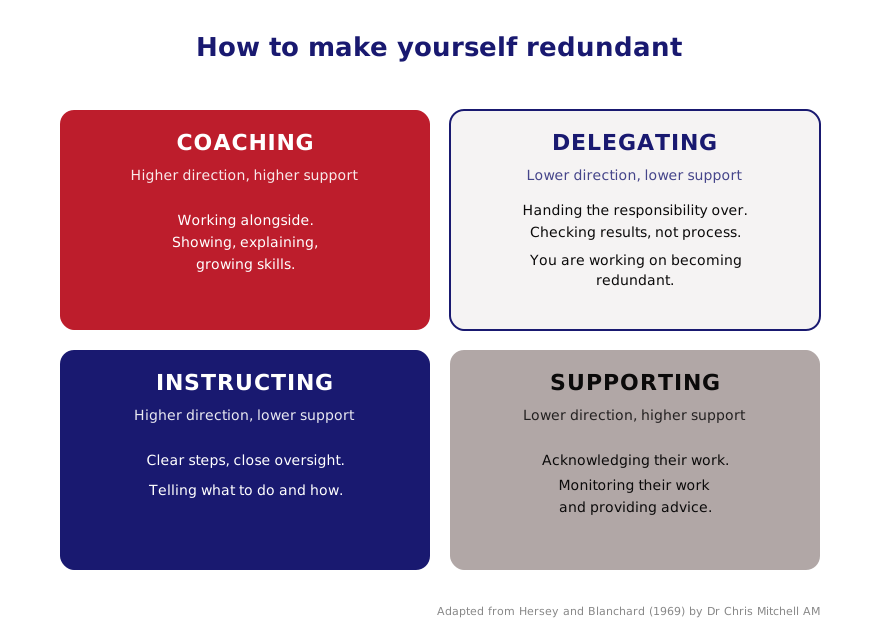
The mistake most owners make is applying the same leadership style to everyone and every task. A practice manager with 15 years of experience does not need to be directed on how to run a staff roster. A new graduate nurse running chronic disease recalls for the first time probably does. Matching your approach to the person's capability and confidence is the whole point. The goal is to build your team's skills, so you need to expend fewer resources over time directing and supporting them.
Research supports this in general practice specifically. Riisgaard and colleagues (2017) found that a high degree of task delegation was associated with higher job satisfaction among both GPs and practice staff. A separate systematic review by the same group (Riisgaard et al., 2016) confirmed the pattern across multiple studies: when delegation is done well, with clear role boundaries and appropriate capability, it benefits the team, not just the owner.
Starting with why
For me, the most important part of delegation begins before the task is assigned. It starts with why. Why does this matter for our community and for the business? When people understand the purpose, and it has to be a purpose they believe in, they can engage with enthusiasm rather than compliance.
Back in the day (around 2012), my team at the National eHealth Transition Authority was tasked with integrating Healthcare Identifiers into Electronic Practice Records to enable information sharing. To share a Shared Health Summary required a complex cascade of steps, but a single failed step meant no ePIP payment. The project required practices to understand seed and networked organisations, to integrate the National Authentication Service for Health (NASH) to enable interaction with the My Health Record, and to implement entirely new workflows. For general practice, this was a requirement for practices to receive the Practice Incentives Program eHealth Incentive (ePIP). We were working with practice managers, primary health care organisations and professional colleges across the country. Achieving any useful outcome through direct instruction would have been impossible. The scale alone ruled it out. What worked was making sure every practice understood why: the ePIP payment was the immediate incentive, but the deeper purpose was giving practices the infrastructure to participate in the national digital health system. The outcome we wanted was for general practice to be successfully registered and rewarded through the ePIP, and that was achieved.
The same principle applies at the practice level, just on a smaller scale. When I delegate a task to my practice manager, the conversation starts with shared values and a clear picture of what we are trying to achieve, not a checklist.
What does effective delegation look like in a practice?
There is a practical sequence that works. Be tight on outcomes but loose on how to get there. Describe what success looks like as specifically as you can. Define who owns the project, the constraints, and any time or budget requirements. Be explicit about the conditions under which they need to come back to you and any approval gates. Then step back and let them work.
When you have a great manager, you can go light on the process. When the skill set is less deep, you need to be more hands-on. That calibration is ongoing.
At a practice level, the complexity of what needs to be delegated is often underestimated. I want to get the most I can from the ePIP and the nurse workforce incentives. The incentives cap out, but I have a branch practice, and the way these practices are accredited and registered makes a material difference to PIP payments. There are also complexities around Telehealth eligibility and GP Chronic Condition Management Plans that can be affected by MyMedicare registration. The Bulk Billing Practice Incentive Program (BBPIP), which commenced on 1 November 2025, adds further layers. All of this needs to be modelled and decisions made. That is not a task you hand to someone without context, capability and clear parameters.
Check-ins, not micromanagement
Set catch-up time in advance
What works for me is a quick check-in or huddle. Twenty minutes together on a Monday morning before clinical work starts can set the week up well and clarify issues before they compound. This is not surveillance. It is a structured rhythm that keeps both parties aligned without the owner hovering over every decision.
Trust but verify
You should not have to check everything, but if you do not check anything, you are abdicating, not delegating. As a practice, you delegate to your manager the responsibility for running a process to ensure Shared Health Summary ePIP targets are met, but it is sensible to check a month before the quarterly deadline to ensure they are on track. That one check can save a quarter's worth of PIP income.
When the BBPIP came out, it caused difficulty in our practice. Some of our GPs wanted to take advantage of the new incentives, while others were opposed. We had both practices on a mixed billing model at the time. Having two practices, separately accredited but in close proximity, gave us the option to pivot one to universal bulk billing while the other remained privately billed. Cubiko gave us some helpful data projections, but verifying that information as the quarter ticked over was critical. The delegation was clear: the practice manager modelled the options, allowing the owners to make a decision, and we checked together the actuals against the projections at each quarter. That is delegation with accountability intact.
When things go wrong
Missteps will always happen. The question is how you respond. Handle mistakes calmly and own them yourself. When a task is delegated, you are still accountable. Take the time to ask what went wrong, explain what you think went wrong, acknowledge what was done well, and discuss how to do even better next time. Every mistake is an opportunity to grow your team's skills, not to erode their confidence.
When everyone is responsible, no one is responsible. Shared responsibility sounds collaborative, but in practice it leads to diffusion: people assume someone else is handling it, deadlines slip and tasks fall through the cracks.
Wicked problems rarely have a simple solution. When things go seriously wrong, it helps to have a structured process for analysis. A fishbone diagram, first described by Ishikawa (1976) and widely used in healthcare quality improvement, is a visual root-cause analysis tool that helps you work out why things broke down. Our processes include a basic template, and at the end, the question comes down to something fairly simple: do we have policies, and were they used? If we do not have a policy, we need to consider whether we need one. If we do, we need to make sure it is fit for purpose, understood and used.
HR complaints can be the most challenging issues in a practice. They affect morale and can lead to significant expense. Given that complex HR disputes are rare in a small practice, it is difficult to maintain on-site expertise. We have been fortunate to delegate complex HR issues to a local HR consultant. The team values an independent review, and as an owner, clear advice on resolution is genuinely helpful. Not every task needs to be delegated internally. Knowing when to bring in external capability is itself a delegation skill.
Recognition and capability
Great leaders take accountability for failures and share their successes across the team, calling out excellence. When you call out excellence, be as specific as you can, with clear examples. Acknowledgment of performance can be in private or in public. There is a place for both. One-on-one performance reviews matter, as do one-on-one counselling sessions when something is not working. A simple, personalised note of thanks can make a disproportionate difference, given the effort it takes.
Great hiring is a wonderful skill, but the ability to exit people from the business is just as important. A poor fit puts the whole team under pressure, and sometimes it is about a bad fit rather than a bad person. Either way, when it is not working out, it is important to have a process to move that person out of your business as painlessly as possible for everyone concerned.
The aim of all of this, delegation, check-ins, structured accountability and recognition, is to build a team that becomes more capable over time. You want to reach the point where you are genuinely delegating: low direction, low support, high trust, high autonomy. That does not happen by accident. It happens because you invested in getting people there.